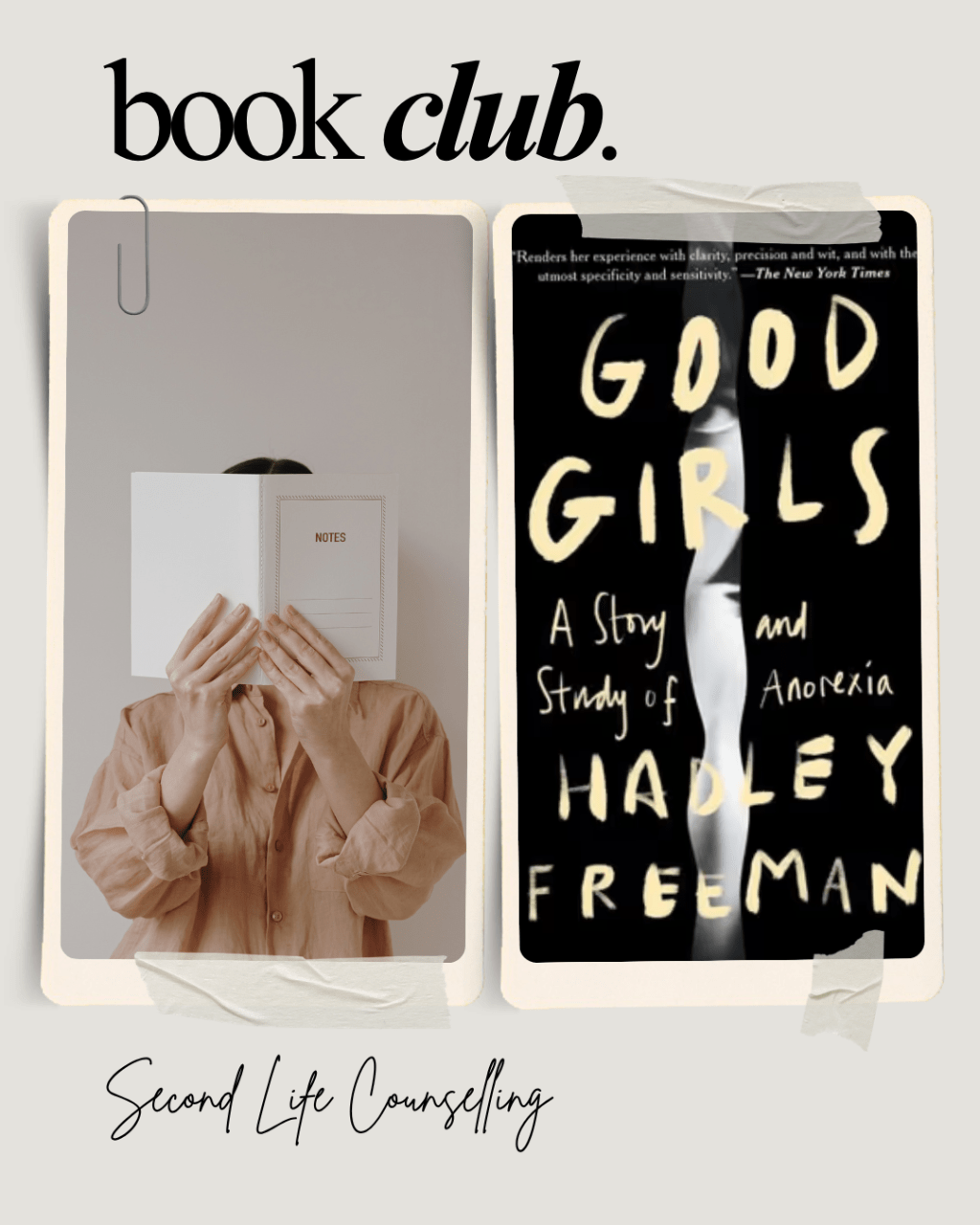
Book Review: Good Girls – A Story and Study of Anorexia by Hadley Freeman
Some books stay with you long after you’ve turned the final page. Good Girls– A Story and Study of Anorexia by Hadley Freeman is one of them.
At first glance, it’s a memoir about anorexia. But as I read it, I realised it is really a book about something much bigger: the impossible expectations placed on women, the search for identity, the need for control when life feels overwhelming, and the long, often messy journey back to ourselves.
As a counsellor working with people navigating life’s biggest transitions, including cancer recovery; I found myself highlighting page after page. Although our struggles may look different on the surface, the emotions underneath are often remarkably similar.
Many of us know what it’s like to lose ourselves, to feel disconnected from our bodies, and to believe we need to be stronger, better, thinner, more productive or somehow “fixed” before we’re worthy.
Freeman writes with remarkable honesty about recovery, reminding us that healing isn’t a single breakthrough moment. It’s gradual, and uneven and sometimes frustratingly slow. And yet, entirely possible.
One passage that particularly resonated with me was:
“Sometimes you need to pretend to be someone else for a bit in order to accept yourself.”
I interpreted this not as pretending to be someone we’re not, but as practising new ways of thinking and living until they become our reality. In counselling, we often encourage clients to experiment with healthier beliefs before they fully believe them. Confidence, self-compassion and hope are often built through repetition, not revelation.
Another quote that stayed with me was:
“I didn’t die, but I didn’t recover for a long time. I was in a gray fog that no one could explain to me, and so I didn’t understand it.”
Anyone who has experienced cancer treatment, grief, burnout or trauma may recognise that “grey fog.” Sometimes recovery isn’t dramatic. It’s simply learning how to live again after survival.
Freeman also captures something many women quietly carry:
“Extreme self-control and self-denial are how so many girls express anxiety…”
While she’s writing about eating disorders, I couldn’t help thinking about how many women express anxiety in different ways – overworking, people-pleasing, perfectionism, putting everyone else’s needs before their own, or believing rest has to be earned. Different behaviours, but often the same underlying story.
One of my favourite lines in the book is beautifully hopeful:
“Sometimes you need to pretend to be someone else for a bit in order to accept yourself.”
Healing often begins before we feel healed.
We choose one kind thought, one healthy meal, one walk, one conversation, one journal entry. And slowly, those small choices become a new life.
What I appreciated most about Good Girls is that Freeman doesn’t offer quick fixes. She acknowledges that recovery is rarely linear, and she refuses to romanticise suffering. Instead, she offers something far more valuable: honesty, compassion and hope.
Whether you’re recovering from illness, trauma, grief or simply trying to rediscover who you are after life has changed you, this book is a powerful reminder that recovery isn’t about becoming the person you were before.
It’s about becoming someone new; with greater compassion, wisdom and resilience.
My takeaway
Healing isn’t about fixing yourself. It’s about finding your way back to yourself.
⭐️⭐️⭐️⭐️⭐️
Love, Michelle


Leave a Reply