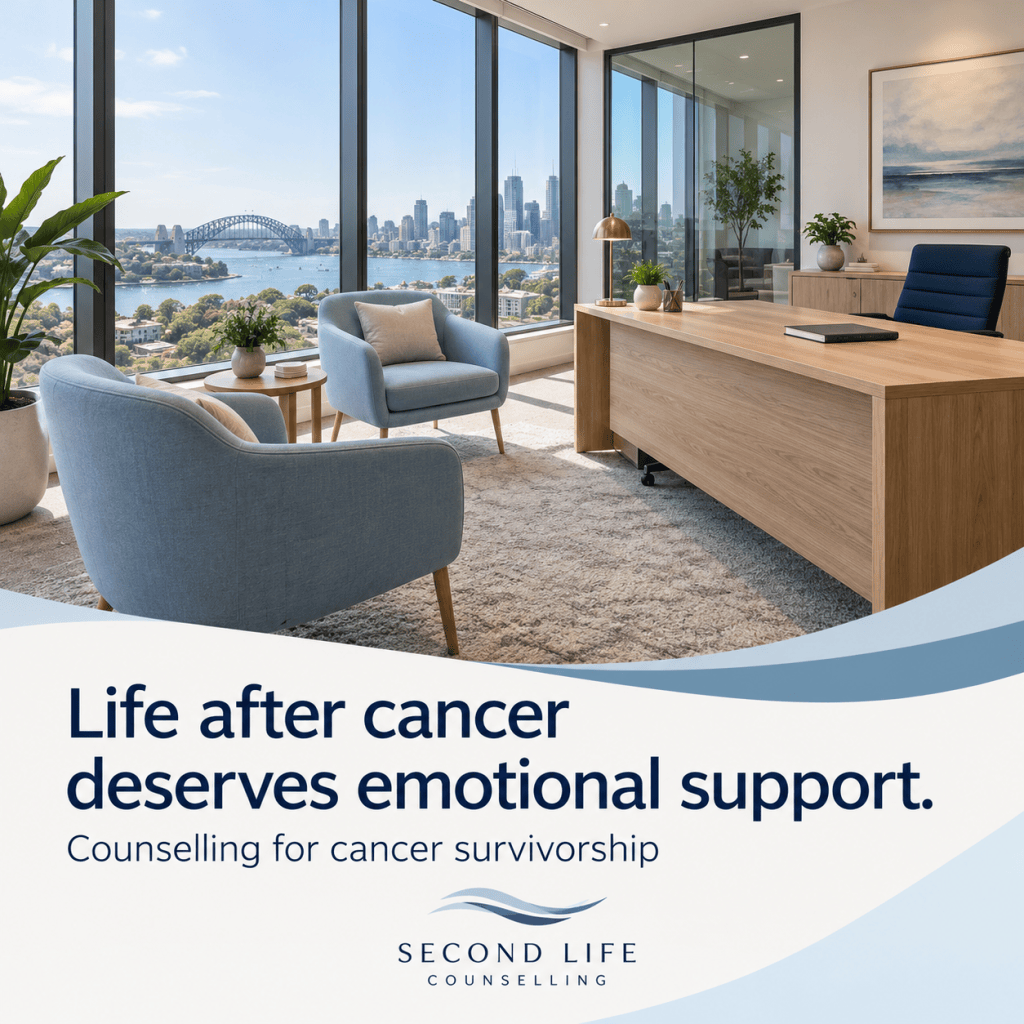
Life After Cancer: Why Emotional Recovery Deserves Support
Finishing cancer treatment can be a moment of enormous relief. After months of appointments, procedures and uncertainty, there may finally be space to breathe.
But emotional recovery doesn’t always follow the treatment calendar.
You might feel grateful and frightened at the same time. You might want to move forward while struggling to trust your body. People around you may be celebrating, while you are still trying to understand everything you have been through.
As a registered counsellor and breast cancer survivor, I believe we need to make more room for these experiences in conversations about life after cancer.
What Australian research tells us
Australian research provides evidence that targeted psychological support can help people experiencing significant fear of cancer recurrence.
The ConquerFear randomised controlled trial, led by Australian researchers, involved 222 survivors of breast cancer, colorectal cancer or melanoma. Participants had completed treatment and were experiencing fear of recurrence above a clinical screening threshold.
The study compared five sessions of a structured psychological intervention with a relaxation therapy program. ConquerFear included approaches focused on attention, beliefs about worry, acceptance, mindfulness and goals connected to personal values.
Participants receiving ConquerFear experienced greater improvements in overall fear-of-recurrence scores than those receiving relaxation therapy. These benefits were maintained at six months.
This was a study of a specific intervention, rather than counselling in general. Its findings nevertheless offer an important message: significant fear after cancer can respond to support designed to address it.
There is more to recovery than finishing treatment
For some people, the end of treatment brings questions they haven’t yet had space to ask.
Who am I after everything that has happened? How do I return to work when I feel different? How do I make plans while living with uncertainty?
In my own experience, surviving cancer and finding my feet afterwards have been different parts of the same story. Relief has existed alongside fear. Gratitude has existed alongside grief for what changed.
There can also be pressure to turn a difficult experience into something positive. Yet you don’t need to find a lesson, feel stronger or have a clear plan before you deserve support.
How counselling can help
Counselling offers a place to talk honestly about your experience, including feelings you may find difficult to share with the people closest to you.
Depending on your needs, this might involve exploring changes in identity, relationships or confidence; finding practical ways to approach uncertainty; or reconnecting with activities and values that matter to you.
The aim is to work towards a life that feels meaningful while acknowledging what you have been through.
Support should be tailored to the individual. Where distress is significant or persistent, assessment and referral to a practitioner with specific psycho-oncology expertise may be appropriate.
You deserve care beyond treatment
My lived experience helps me appreciate the uncertainty that can accompany survivorship. My counselling training informs how I support others, while recognising that every person’s cancer experience is their own.
At Second Life Counselling, I offer a compassionate space to explore life during and after cancer, at your own pace.
If you would like support, contact me to arrange a free 15-minute introductory consultation. Telehealth appointments are available, so you can attend from a private, comfortable space.
Michelle Aziz | ACA Registered Counsellor | Breast Cancer Survivor
Research reference: Butow and colleagues (2017), “Randomized Trial of ConquerFear: A Novel, Theoretically Based Psychosocial Intervention for Fear of Cancer Recurrence,” Journal of Clinical Oncology.


Leave a Reply